
- Pete Hegseth has commissioned a future warfare study
- A new command will lead autonomous warfare
- The 2027 Defense R&D Summit will explore unmanned systems, quantum and more
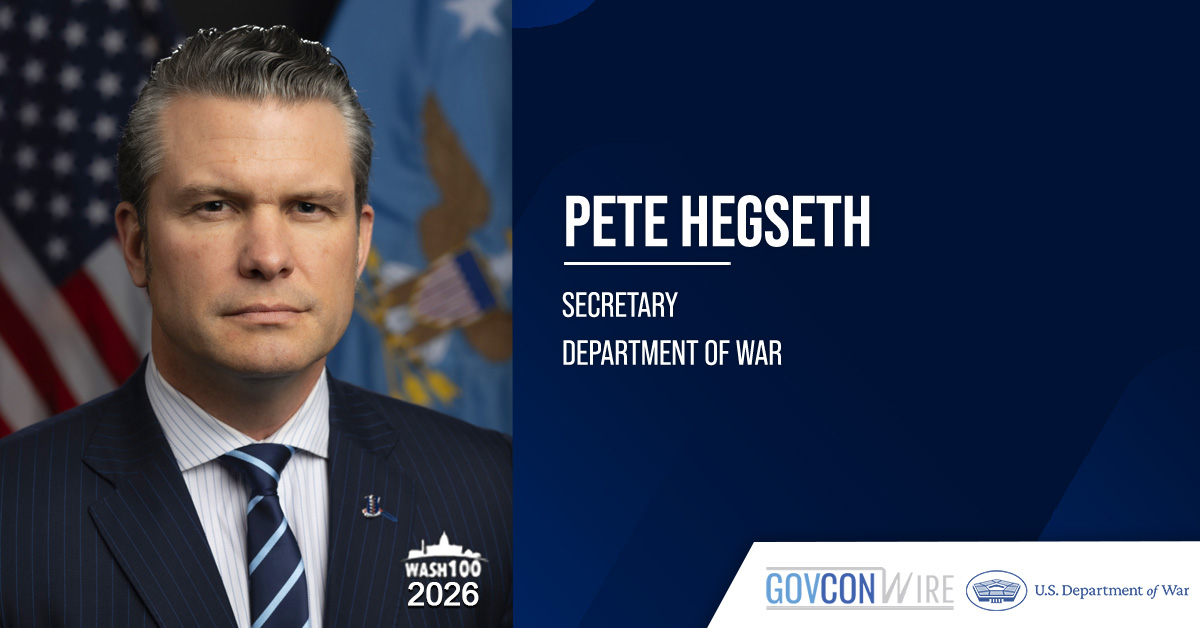
Secretary of War Pete Hegseth, a two-time Wash100 awardee, has unveiled six strategic initiatives that will shape the Department of War’s priorities in the years ahead.

Project Meridian will identify the weapons and technologies warfighters will need on future battlefields, and the planned Autonomous Warfare Command will lead the joint force in unmanned and autonomous warfare. Unmanned systems, trusted AI and autonomy, quantum computing, directed energy and advanced space technologies will be among the topics at the Potomac Officers Club’s 2027 Defense R&D Summit on Feb. 4. Register now to hear from DOW and national security technology officials on future research and development investments.
The department said Wednesday Hegseth presented the framework at Marine Corps Base Quantico in Virginia, where he briefed active-duty E-6 and O-3 personnel responsible for carrying out the reforms.
What Initiatives Did Hegseth Announce?
- Project Meridian
- Autonomous Warfare Command
- America’s Corps of Cadets
- FORTRESS America
- Next Great American Base
- Office of Religious Affairs
What Is Project Meridian?
Project Meridian is a 120-day initiative that will examine future battlefields and determine which weapons and technologies U.S. warfighters will need to prevail in them. Its scope extends across warfighting domains, from underground environments to cislunar space.
Hegseth tasked DOW Chief Technology Officer Emil Michael, a 2026 Wash100 honoree, with commissioning the project through a partner organization. Elon Musk, founder and CEO of SpaceX and a previous Wash100 awardee, will co-direct the effort alongside Anduril Industries Co-Founder Palmer Luckey and former House Speaker Newt Gingrich. A team of academic, policy and industry experts will support the project.
The project team will chart how warfare is likely to evolve, identify gaps in critical capabilities and recommend ways to develop, test and field new systems in support of the 2026 National Security Science and Technology Strategy. Hegseth asked the Joint Staff and the military services to be ready to link their future warfare research to the project.
Findings and recommendations are due to Hegseth’s office by Jan. 28, 2027. The project will produce a public, unclassified final report along with a classified annex.
What Is the Autonomous Warfare Command?
Autonomous Warfare Command is a planned four-star functional combatant command that will oversee unmanned and autonomous warfare for the joint force. Once established, the command will hold its own manpower, budget and acquisition authorities, create career tracks for officers and enlisted personnel, set joint requirements and integrate service forces to support geographic combatant commanders.
Hegseth directed the Direct Reporting Portfolio Manager for Unmanned Systems, or DRPM-UxS, to lead Project Agincourt, the effort to stand up the command by its Oct. 1, 2027, target date. DRPM-UxS will coordinate with Congress on required legislation and test a new acquisition approach for unmanned and autonomous systems.
Owen West, director of the Defense Innovation Unit and a 2026 Wash100 award recipient, will serve as CEO of DRPM-UxS, while Navy SEAL Senior Chief Max Strasiser will serve as chief operating officer. The office has 30 days to submit a plan of action and milestones for Hegseth’s approval, with support from the chairman of the Joint Chiefs of Staff.
Which Other Programs Are Part of Hegseth’s Framework?
America’s Corps of Cadets will expand officer commissioning through new full-time cadet programs at Louisiana State University, Liberty University, Tuskegee University, Mississippi State University and Hillsdale College. Each school will be designated a Distinguished Military College and receive Honor School status, giving it priority in officer commissioning.
FORTRESS America, short for Federal Operations for Resilience, Troop Resources, Energy, Supply and Survivability, calls for U.S. military installations to generate their own power and for production of rare earths, specialty metals, semiconductors and propellants to return to the U.S. The program also covers larger reserves of munitions, fuel, medicine and blood and protection of bases against cyberattacks, sabotage and drones.
Next Great American Base will be a newly built installation spanning hundreds of thousands of acres, with independent power generation, autonomous systems, air defenses and classical architecture. States will compete to host the base, with governors and adjutants general presenting proposals to DOW leadership.
The Office of Religious Affairs will report directly to the secretary of war and lead departmentwide religious affairs policy and resource advocacy. Service chaplaincies will remain the primary providers of religious support, and the office will not require religious participation or favor any faith.
How Is DOW Reshaping Its Senior Military Leadership?
During the address, Hegseth also outlined a 20 percent reduction in general and flag officer positions across the military. The new target doubles the 10 percent reduction he directed in May 2025. That memo also called for cutting at least 20 percent of active-duty four-star positions and National Guard general officers.
Hegseth approved reduction plans for the Army, Air Force, Navy and the military’s joint pool in early September, according to Fox News. The services have until Jan. 1, 2027, to complete the changes. A War Department source told the outlet the cuts apply to billets, or positions designated for generals and admirals, and do not remove 20 percent of the officers currently holding those ranks. Some of the positions will be downgraded so colonels and Navy captains can fill them.
In the 2025 memo, Hegseth said reducing excess senior positions would remove bureaucratic layers and support greater efficiency, innovation and readiness. He has described the approach as “less generals, more GIs.”
In his remarks, Hegseth described the reductions as “accountability and long overdue” and tied them to the department’s broader cultural reforms.
“You can’t change a culture with the same people who enabled it,” he said. “Personnel is policy at every single level.”
How Do the Initiatives Build on Recent DOW Efforts?
The latest DOW initiatives follow a series of moves to consolidate and scale the department’s unmanned and autonomous systems work. Hegseth previously created a direct reporting portfolio manager role to oversee nearly all drone and counter-drone programs, and the Army has since awarded 10 counter-drone indefinite-delivery/indefinite-quantity contracts under the Domestic Shield effort.
Joint Interagency Task Force 401 recently signed a memorandum of understanding with the National Nuclear Security Administration to strengthen collaboration on counter-unmanned aircraft systems. The Navy awarded production agreements for medium unmanned surface vessels to three companies.
Project Meridian, which Michael will facilitate, comes as the department continues its overhaul of the defense innovation ecosystem under his direction. Defending the U.S. homeland is the top priority in the department’s 2026 National Defense Strategy.